Networked manufacturing platform for tool-making at ESCHA GmbH & Co. KG in Halver
From a stand-alone system to autonomous production
A wide range of materials, high precision requirements, and the desire for long unmanned running times posed major challenges for ESCHA’s tool-making department in Halver. With a VERSA 945 from Fehlmann, flexible Gibas automation, and the EVOMECS control system, a manufacturing solution was created that increases machine uptime by more than 70 percent while significantly reducing tool breakage. In addition, ESCHA was able to increase on-time delivery rates to 88 percent and, at the same time, digitize tool management and order control.
For over 40 years, ESCHA GmbH & Co. KG has been developing, manufacturing, and marketing high-quality connection technology, enclosure technology, and specialized solutions for demanding environments with high protection ratings such as IP67 through IP69. Whether sensor/actuator connectors, data and power connectors, valve connectors, I/O modules, or custom connection solutions and cable assemblies — ESCHA provides the critical interfaces for industrial applications. These range from automation technology and mechanical engineering to the food industry, rail and transportation technology, and renewable energy.
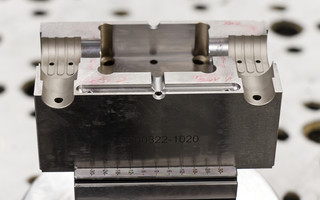
Serving as the technological backbone of its own manufacturing, ESCHA operates an in-house tool and mold making department. This is where the complex injection molds, fixtures, and mold inserts are created. These later form the basis for the production of millions of connectors. Benjamin Unruh, project manager at ESCHA, describes the department’s previous role as follows, “We manufacture the fixtures and mold components for our production. When we talk about the ‘customer’ in tool-making, that has always actually meant our internal customers.” This allows the tool-making department to ensure that ESCHA can respond flexibly to market demands and cost-effectively produce both standard products and custom solutions.
Need for action in tool and die making
However, the existing milling processes in tool and mold making were increasingly unable to meet ESCHA’s requirements. The two older HSC milling machines processed a wide range of materials in mixed-mode operation—from engineering plastics and graphite to copper alloys and aluminum, all the way to tool steels and stainless steel. Although the spindles, designed for high speeds, were ideal for finishing tasks, they proved to be underpowered for more demanding machining processes.
Additional challenges arose regarding process reliability. Due to insufficient coolant lubrication, chips frequently adhered to components and clamping devices. This repeatedly led to disruptions in automated handling, including robot collisions. At the same time, machining processes had to be slowed down to prevent tool breakage. Long tool change and cleaning times further reduced productivity. Small tool magazines, limited workpiece dimensions, and low pallet capacity made it difficult to achieve long autonomous run times.
In addition to the technical challenges, there was also a need for organizational action. “Tool management and production planning were largely based on manual processes. We had a veritable Excel landscape,” recalls Unruh. “Tool discrepancies were calculated once a day, and if anything came in after that, the job just had to wait.”
Clear requirements instead of gut feelings
For ESCHA, it was clear from the start that the project would be significantly larger than simply replacing a milling machine. The company was looking for an end-to-end digital process chain—from order receipt to the finished component. That’s why a comprehensive digitization strategy for tool-making was developed first. The goal was to make all processes more transparent, standardized, and controllable through data. Thus, at the end of 2021, ESCHA implemented EVOMECS’ MES and control system with tool and job management. At the same time, a detailed requirements specification was developed for the “BRZ 2.0” project, outlining numerous technical requirements for machinery, automation, and digital integration. After all, ESCHA knew exactly where the existing processes had shortcomings.
The objectives were clearly defined: repair costs were to be reduced by 70 percent, process reliability significantly increased, and processing times per component reduced by around 30 percent. At the same time, the goal was to enable largely autonomous manufacturing with long unattended runs. Another important criterion was integration into the EVOMECS control system.
Fehlmann VERSA 945: a flexible all-rounder
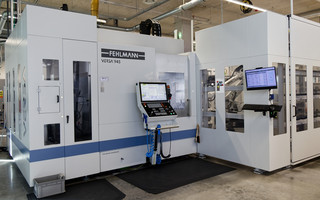
After an in-depth market analysis, the decision was ultimately made to go with the VERSA 945 machining center from Fehlmann, combined with a customized automation solution from Gibas. “The Fehlmann solution met 94 percent of our requirements—the highest percentage,” explains Benjamin Unruh. “We also knew from past experience that we could rely on Fehlmann for both technology and service.” ESCHA has been using a Fehlmann PICOMAX 56 as a stand-alone machine for many years. Particularly positive experiences with their service had built trust early on. “You’re not just buying the hardware,” emphasizes Benjamin Unruh. “You’re also buying service and trust.”
Technically, the VERSA 945 was a very good fit for the requirements profile. The machine combines high precision with robust torque, making it ideally suited for the mix of materials used in ESCHA’s tool-making. Unlike pure high-speed machines, Fehlmann deliberately positions the VERSA as a universal platform for a wide variety of machining tasks. “The customer doesn’t always need a racehorse,” says Alain Strebel, Sales Manager for Germany and Northern Europe at Fehlmann AG, describing the machine’s philosophy. “Often, they need more of a galloper—that is, a machine that can reliably handle many different tasks.”
Combining high stability and precision
The VERSA 945 installed at ESCHA combines a spindle speed of 24,000 rpm with a torque of 74 Nm, thereby covering an extremely wide range of materials. A highlight is the integrated abrasive protection package, which effectively protects the guideways when machining highly abrasive plastics.
The VERSA 945 also differs from previous systems in terms of its design. Instead of a classic gantry design, Fehlmann relies on a portal structure with decoupled axes. The closed portal absorbs machining forces particularly effectively and ensures high rigidity throughout the entire machine. “The portal design gives us exactly the combination of stability, precision, and flexibility that we need for our tool-making. This allows us to reliably machine a wide variety of materials and component sizes on a single machine,” summarizes Benjamin Unruh.
In addition to performance specifications, the machine’s automation capabilities also played a key role. The VERSA 945 was designed from the outset for automated operation and offers numerous design advantages for this purpose: Thanks to the separate access point for automation, the operator can set up tools or monitor the process from the front at any time, while the robot prepares the next pallet from the side. With 256 tool stations in the rack magazine, capacity issues for “lights-out” production are no longer a problem. The 80-bar internal cooling system tackles chips right where they are generated. This ensures stable processes and prevents the dreaded tool breakages.
Flexible manufacturing cell for autonomous operation
Fehlmann has been working closely with the Dutch automation specialist Gibas for many years. “Given ESCHA’s requirements for flexibility, different clamping systems, and the open integration of the EVOMECS control system, it was clear to us from the start that Gibas would be our partner for automation,” explains Alain Strebel. “We’ve already implemented many joint systems in the Netherlands and knew that Gibas is open to these types of customer-specific solutions.” It was precisely this openness that was decisive for ESCHA. “That was ultimately one of the most important factors,” recalls Benjamin Unruh. “Many competitors wanted to bring in their own system. Both Fehlmann and Gibas were willing to embrace our concept and integrate the entire system into the existing EVOMECS environment.”
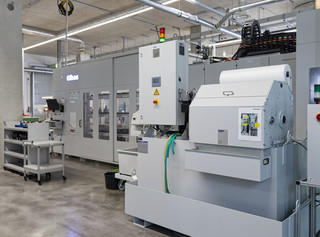
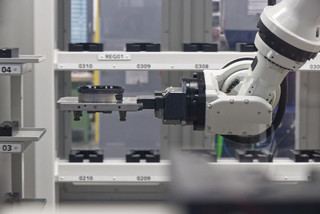
At the heart of the system is a centrally located robot cell equipped with a Fanuc robot. Since the components range from small electrodes to large mold plates with workpiece contours, the automation had to be designed to be correspondingly flexible. As a result, the system can process three different clamping systems simultaneously—ITS50, ITS148, and UPC320. A total of 100 ITS stations and twelve UPC stations are available.
Customized automation instead of a standardized solution
Because ESCHA wanted to equip the system with large sliding doors for fast loading and unloading, it was necessary to ensure that no incorrectly positioned pallets entered the machine. The solution is an optical 2D code system: “The robot is equipped with a specialized barcode scanner and a laser sensor for presence detection. This system serves as a critical safety feature. Before each transfer into the VERSA 945, the robot scans the pallet at the transfer station and verifies its identity and correct orientation,” explains Enrico Akkerman, CCO at Gibas.
Another key element is the integrated washing station within the automation cell, which Gibas developed specifically to meet ESCHA’s requirements. Enrico Akkerman explains: “Conventional industrial washing systems typically use thermal drying. However, this poses a problem for high-precision tool components, as the heat can cause them to warp. That’s why our solution operates at ambient temperature and is controlled directly by the EVOMECS control system. Depending on the material and component geometry, the system automatically selects the appropriate cleaning program.”
EVOMECS serves as the digital brain for manufacturing
Thanks to the EVOMECS MES and control system, the manufacturing cell has been transformed into a fully networked production platform. It digitally controls, monitors, and links virtually the entire tool-making process. “For us, it all starts in the order management system,” explains Benjamin Unruh. “The customer places an order, and this automatically generates the tasks for production. All processes — from design through CAM, tool management, and milling to EDM, assembly, and quality assurance—are centrally organized via EVOMECS. The system handles the entire order management process. From CAM programming through tool management and machine scheduling to quality assurance, all work steps are coordinated centrally.”
Digital tool management plays a central role in the new manufacturing concept. EVOMECS automatically records, manages, and monitors the tools, including their service life. This allows ESCHA to know at all times which tools are available, how long they have been in use, and whether they will be sufficient for upcoming orders. As with the workpieces, the tools are identified via a 2D barcode and automatically added to the tool library. They are loaded into the magazine via a quick-change door.
“To prevent tool breakage, we used to play it safe and change tools early. Today, we make decisions based on real machine data. We know at all times which tool has been in use, how long it has been running, and how much remaining service life is available. This gives us significantly more reliability and transparency throughout the entire manufacturing process,” explains Benjamin Unruh.
Over 70 percent more productive machine uptime
With the new manufacturing platform, ESCHA has exceeded its original goals in many areas. This is particularly evident in machine runtime. While the previous solution achieved an average of only about 8.75 hours of productive runtime per day, the new system now runs productively for an average of about 15 hours daily. “That represents an increase of over 70 percent,” says Benjamin Unruh with satisfaction. “And the runtime is now much more stable and predictable.”
Thanks to stable cooling, greater process stability, and digital tool monitoring, tool breakage and waste have been significantly reduced. At the same time, the tools operate with much greater reproducibility and suffer less wear. “We’re milling much more consistently today. The tools run in a more controlled manner. We have less wear, which leads to more stable processes and better machining quality.”
Tool-making is now more efficient. At the same time, on-time delivery has improved dramatically — from about 55 percent previously to around 88 percent today. “The processes are now much more transparent and easier to plan,” says Unruh. “This allows us to respond more flexibly to last-minute changes. And so we’ve also started processing orders from external customers.”
Employees involved early on
To ensure the transition to the new manufacturing platform went as smoothly as possible, a four-stage training program was implemented. First, machine training was conducted on the VERSA 945. Employees were then trained on Gibas Automation, followed by intensive training on the EVOMECS control system. In the fourth stage, the project management team finally taught the workflows and processes specifically tailored to ESCHA.
“We wanted to fully involve the employees,” emphasizes Benjamin Unruh. “In my view, the high level of acceptance of the new systems is a key success factor for the project. After all, it is the combination of modern technology and qualified employees that enables the stable and largely autonomous manufacturing we sought to achieve with this project."
Working together toward a networked manufacturing platform
The result is a fully integrated manufacturing platform in which the machine, automation, and MES system work in close coordination. The Fehlmann VERSA 945 ensures the necessary precision and process stability, Gibas automation enables long autonomous runtimes, and EVOMECS connects all processes into a centrally controlled digital process chain.
In addition to the performance of the individual components, close collaboration among all parties involved was crucial to the project’s success. ESCHA, Fehlmann, Gibas, and EVOMECS worked closely together from the very beginning to optimally align the technical, organizational, and digital requirements. Challenges were also resolved through partnership during commissioning and the subsequent optimization phase.
The results speak for themselves: longer machine uptime, greater process reliability, significantly improved on-time delivery, and a manufacturing process that is now much more transparent and flexible than before. Thanks to the new manufacturing platform and the additional capacity created in collaboration with EVOMECS and Fehlmann, the toolmaking division no longer serves only ESCHA’s in-house production but is increasingly expanding its services to external customers.
Advantages of the manufacturing solution featuring the Fehlmann VERSA 945, Gibas automation, and the EVOMECS control system:
- +70% productive machine uptime
- Approx. 30% shorter machining times
- 88% on-time delivery rate (up from 55%)
- Significantly fewer tool breakages
- Largely autonomous manufacturing
Contact
ESCHA GmbH & Co. KG
Märkische Straße 8
58553 Halver, Germany
www.escha.de
Photos and report by KSKOMM, Phone +49 2623 7990160, E-Mail: info@kskomm-nospam.de